JEE Advanced 2026: High Weightage Topics in Physics for IIT Aspirants
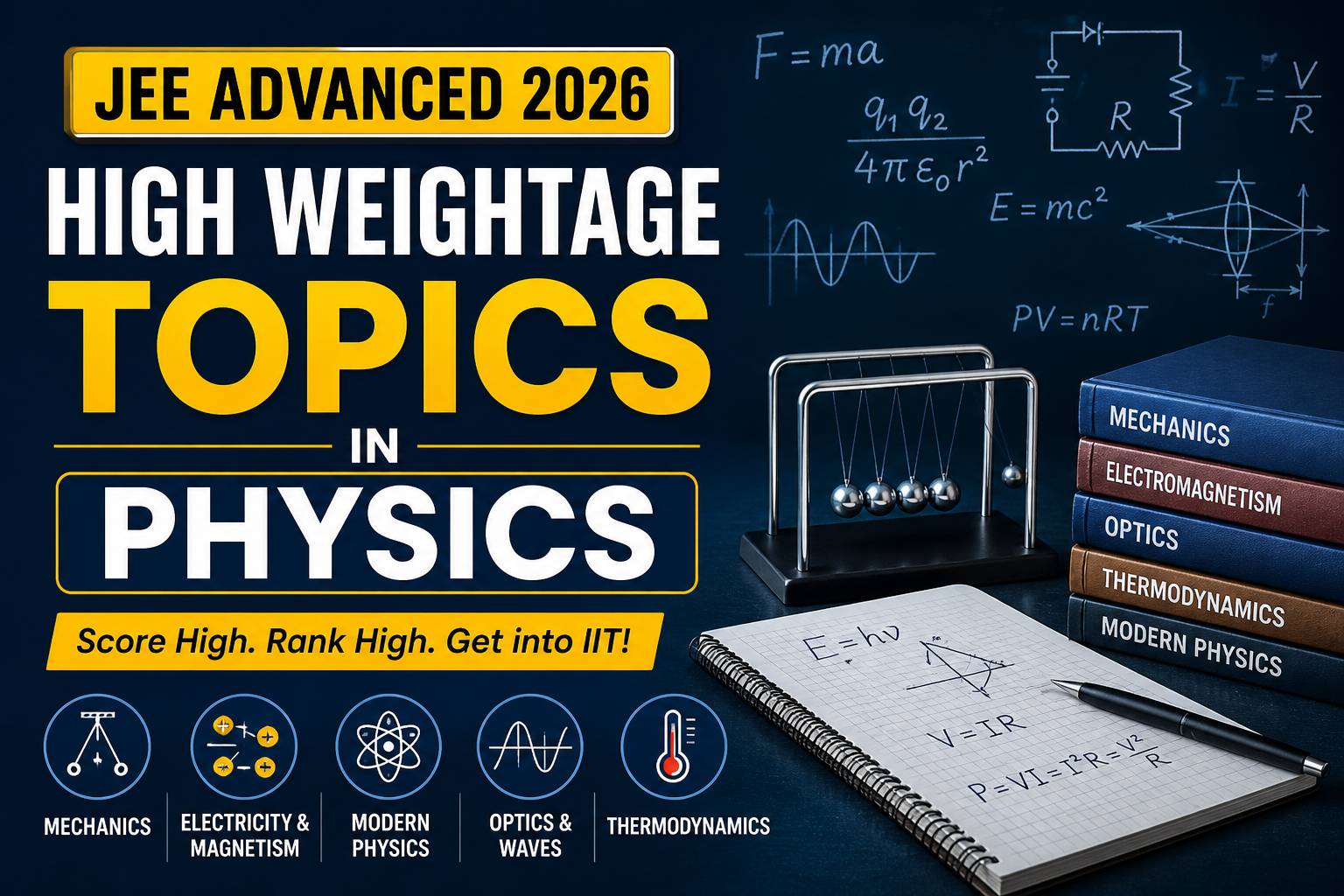
As the JEE Advanced 2026 examination approaches, candidates are focusing on the most important and scoring sections of the Physics syllabus. Physics is often considered one of the toughest sections in JEE Advanced due to its conceptual and numerical-based questions. However, proper preparation of high-weightage topics can significantly improve scores and overall rank.
Experts suggest that aspirants should now prioritize chapters that frequently carry higher marks in previous years’ examinations. A strategic approach towards these topics can help students maximize accuracy and save time during the exam.
Mechanics Remains One of the Most Important Sections
Mechanics continues to dominate the Physics paper in JEE Advanced. Students should focus on understanding concepts clearly instead of rote learning formulas.
Important topics include:
- Laws of Motion
- Work, Power and Energy
- Rotational Motion
- Centre of Mass
- Gravitation
- Fluid Mechanics
- Simple Harmonic Motion
Regular numerical practice from these chapters can improve problem-solving speed.
Electricity and Magnetism Carry Significant Weightage
Questions from Electrostatics and Current Electricity are commonly asked in both Paper 1 and Paper 2. Students should focus on circuit analysis, electric fields, capacitors, and magnetic effects of current.
Important chapters include:
- Electrostatics
- Current Electricity
- Capacitance
- Magnetic Effects of Current
- Electromagnetic Induction
- Alternating Current
solve previous years’ questions for better conceptual clarity.
Modern Physics Can Be Highly Scoring
Modern Physics is considered one of the easiest and most scoring portions in the exam. Questions are generally formula-based and less time-consuming.
Students should revise:
- Photoelectric Effect
- Bohr’s Atomic Model
- Nuclear Physics
- Radioactivity
- Semiconductors
A strong grip on formulas and applications can help students score quickly in this section.
Optics and Waves Are Conceptually Important
Ray Optics and Wave Optics frequently appear in the examination. Students should practice diagrams, lens formulas, and interference concepts carefully.
Important topics include:
- Reflection and Refraction
- Lenses and Mirrors
- Wave Optics
- Interference and Diffraction
- Doppler Effect
Thermodynamics and Heat Transfer Should Not Be Ignored
Thermodynamics is another high-weightage unit that requires conceptual understanding and formula application.
Students should revise:
- Laws of Thermodynamics
- Kinetic Theory of Gases
- Heat Transfer
- Calorimetry
Preparation Tips for Physics
- Focus on concept clarity instead of memorization
- Solve previous years’ JEE Advanced papers
- Practice numerical questions daily
- Revise formulas regularly
- Attempt mock tests under timed conditions
- Strengthen weak chapters through short revision notes
With only limited time remaining before JEE Advanced 2026, aspirants should focus on mastering high-weightage Physics topics through smart revision and regular practice. Chapters such as Mechanics, Electrostatics, Modern Physics, Optics, and Thermodynamics have consistently played a major role in the examination pattern over the years.
Frequently Asked Questions
Which Physics chapter has the highest weightage in JEE Advanced 2026?
Mechanics generally carries the highest weightage in the Physics section.
Is Modern Physics important for JEE Advanced?
Yes, Modern Physics is considered one of the most scoring and easier sections.
How should students prepare Physics in the last phase?
Students should revise formulas, solve mock tests, and practice previous years’ questions regularly.
Are NCERT books enough for JEE Advanced Physics?
NCERT helps build concepts, but additional problem-solving practice is necessary for JEE Advanced level preparation.